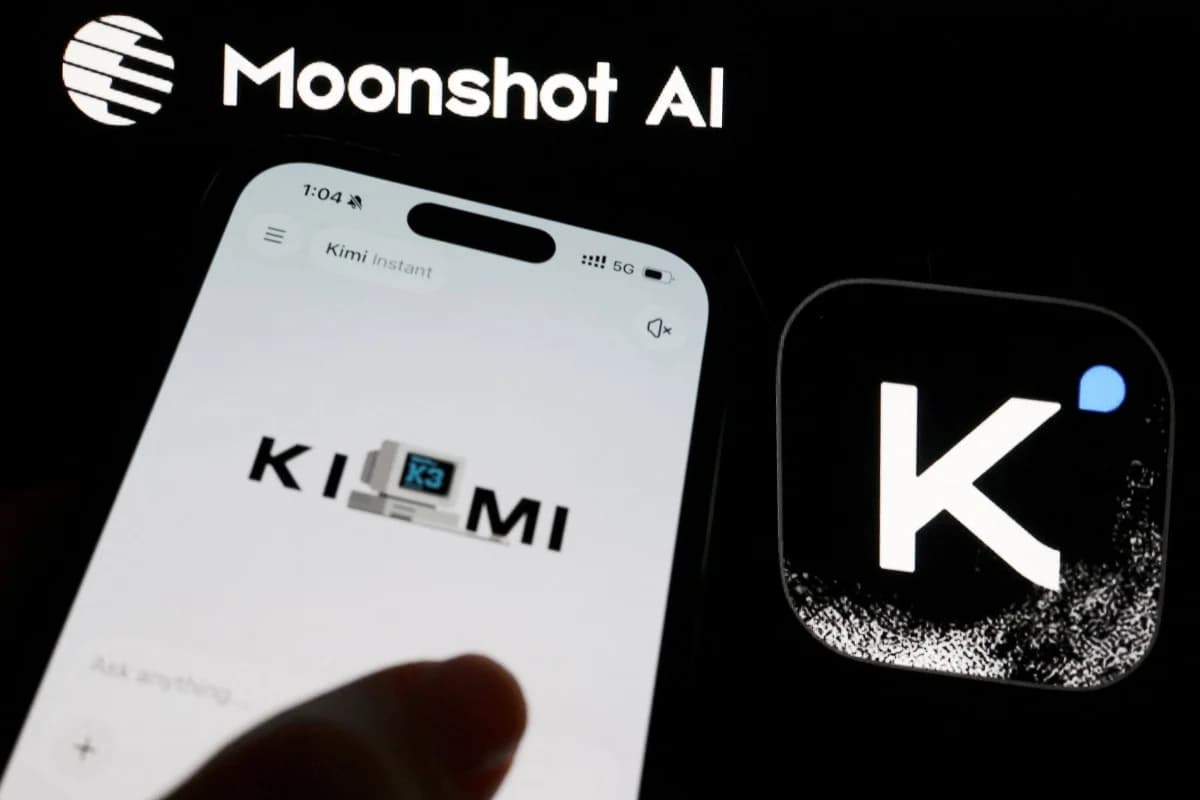
Moonshot AI, developer of the Kimi conversational model, is exploring a rare dual-listing strategy on the Hong Kong and Shanghai exchanges, having already confidentially filed for a Hong Kong IPO targeting roughly $3 billion, backed by Goldman Sachs, China International Capital Corporation, Deutsche Bank, and Bank of America.
The valuation trajectory behind this filing has no recent equivalent: from a $4.3 billion valuation at the end of 2025, to $20 billion in May 2026, to $30 billion in July, to a confidential $50 billion Hong Kong filing in early September, an eleven-fold increase in under nine months. The catalyst is singular and clearly dated: the July 16 launch of Kimi K3, a 2.8-trillion-parameter open-weight model that Moonshot presents as the largest ever released, which triggered a sixfold increase in daily sales.
Moonshot's annual recurring revenue rose from roughly $100 million in March 2026 to about $300 million by July, a genuine tripling, more than 70% of it from API-driven services rather than volatile consumer subscriptions. Even so, a $50 billion valuation against that figure implies a multiple above 150, an extreme level even by growth-stage AI standards, especially given that running a 2.8-trillion-parameter model carries a permanent, growing compute cost rather than a one-time development cost amortized over time.
Moonshot remains, despite this rise, less valuable than its two main domestic rivals: DeepSeek, valued around $74 billion in its own ongoing round (covered above), and Z.AI, whose market value stands at roughly $66 billion. The dual-listing exploration should be read as an attempt to secure broader capital access while spreading regulatory risk across two jurisdictions with very different profiles, Hong Kong being more internationally exposed and therefore more vulnerable to a US extraterritorial sanction, Shanghai's STAR Market offering a domestic route largely insulated from US jurisdiction.
Moonshot is, notably, the company treated with the most specificity in the September 8 national security advisory covered above: it is explicitly accused of distilling Claude to build Kimi K3, the very model behind its valuation surge, and of illegally using export-banned Nvidia chips via Thailand-based servers, an investigation opened by the Commerce Department as early as July 2026. Should that investigation land an Entity List designation before the listing process concludes, the impact on Moonshot's valuation thesis could be significant, a scenario the dual-listing structure itself seems to anticipate.
The dual-listing exploration itself is a useful leading indicator of how Moonshot's own management privately weighs its regulatory exposure: a company confident in its standing would not typically need to spread listing risk across two jurisdictions with very different exposure profiles.
We see three dimensions worth tracking for any exposure to this name: the timing gap between the confidential filing and any eventual Entity List decision, which constitutes a window of maximum vulnerability, the outcome of the Commerce Department's investigation into the alleged chip and distillation violations, and the sustainability of the underlying multiple as Chinese peers like Alibaba, Tencent, Baidu, and Zhipu AI begin raising API prices after a period of aggressive discounting, a signal that China's generative AI market is entering a more disciplined, profitability-seeking phase.
ZINVEO ne décide pas. ZINVEO expose l'asymétrie structurelle. La décision finale revient
au comité d'investissement.
Recherchez dans notre couverture, ou demandez un accès direct au moteur de risque structurel de ZINVEO.
