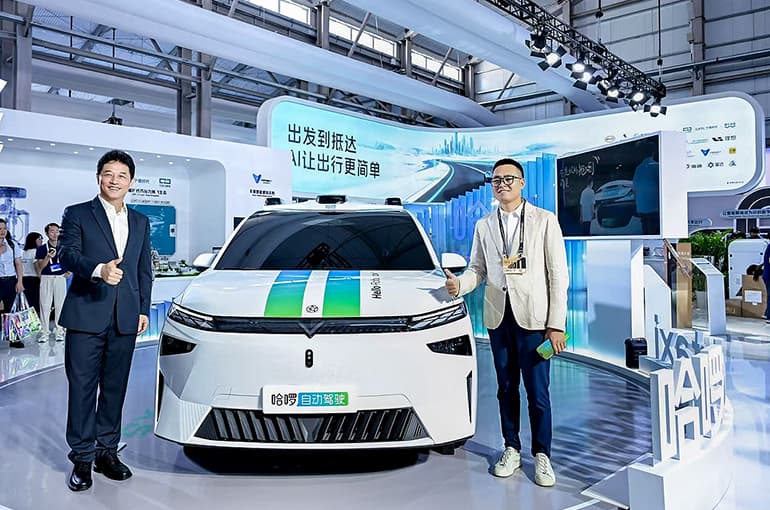
Shanghai-based Hello Robotaxi, operated through the entity Shanghai Zaofu Intelligent Technology Co., Ltd., raised approximately $100 million in fresh funding, led by Shanghai Guotou's Pioneer Fund, with Minjin Investment and Genesis Capital also participating. The financing values the business at nearly $3 billion post-money, a substantial step up from the roughly $420 million initial capitalization at the company's founding.
Shanghai Zaofu Intelligent Technology was formed in June 2025 as a joint venture between ride-hailing and bike-sharing platform Hello (formerly Hellobike), fintech giant Ant Group, and EV battery maker CATL, three companies with a pre-existing partnership history dating back to a 2019 battery-swap joint venture for two-wheeled electric vehicles. At founding, the three parties committed over 3 billion yuan (roughly $417-420 million) in initial investment, with the entity registered with 1.288 billion yuan in capital. The venture's stated purpose from inception was Level 4 autonomous-driving R&D, safety validation, and eventual commercialization, combining Hello's urban mobility data and user base, Ant Group's AI and data-security expertise, and CATL's battery and intelligent-chassis technology. Alibaba subsequently made a strategic investment as well, further widening the shareholder base beyond the original three founding partners.
The choice of name is itself worth noting: Zaofu references a legendary charioteer from China's Western Zhou Dynasty, renowned in Chinese mythology for his mastery of horse-drawn vehicles, a branding decision that signals the venture's ambition to position itself as a foundational entrant into China's autonomous-mobility future, rather than a narrow product extension of Hello's existing bike-sharing business. At founding, Zaofu set out an ambitious operational target of deploying 100,000 smart electric vehicles and 500 battery-swapping cabinets across 20 Chinese cities, including Shanghai and Chengdu, by the third quarter of 2025, a target whose actual achievement has not been independently verified, and which should be treated with appropriate skepticism given the gap between ambitious initial roadmaps and realized deployment commonly observed across China's autonomous-vehicle sector.
What makes this particular round worth watching is less the amount than its intended use: Hello Robotaxi plans to deploy the capital toward building a computing platform at the scale of roughly 10,000 GPUs, developing end-to-end autonomous-driving models, and strengthening a higher-quality data supply chain. This is a materially different capital-allocation priority than the company's original 2025 mandate, which centered on fleet deployment and battery-swap infrastructure. The shift toward large-scale compute and end-to-end model architecture signals that Hello Robotaxi is repositioning itself technologically to compete more directly with the vision-based, model-centric approaches pursued by Tesla and, domestically, by newer entrants, rather than relying solely on the more traditional sensor-fusion stack associated with established players like Baidu's Apollo Go.
This pivot toward an end-to-end, data-hungry model architecture also has direct implications for the company's cost structure and time-to-profitability. End-to-end autonomous-driving models, of the kind pioneered publicly by Tesla's Full Self-Driving stack, typically require substantially larger and more continuously refreshed training datasets than modular sensor-fusion pipelines, since the model must learn to map raw sensor input directly to driving decisions without hand-engineered intermediate representations. Building and maintaining a 10,000-GPU-scale training platform is a multi-year, capital-intensive commitment that implies Hello Robotaxi's investors are underwriting a technology bet with a payoff horizon considerably longer than the typical venture-return timeline, betting that the platform-level advantages of an end-to-end approach will ultimately outweigh the substantially higher upfront compute and data-acquisition costs relative to competitors still relying on more conventional architectures.
China's robotaxi sector remains structurally divided into three archetypes: technology-company-led platforms such as Baidu's Apollo Go and Pony.ai, which have invested over 150 billion yuan cumulatively and lead on testing-mileage data; ride-hailing-platform spin-offs such as Hello Robotaxi and Caocao Mobility, which bring large existing user bases and urban mobility data but less deep autonomous-driving R&D history; and standalone autonomous-vehicle specialists. Goldman Sachs has projected China's robotaxi market could grow from roughly $54 million in 2025 to $1.2 billion by 2030, implying a compound annual growth rate exceeding 90%, a trajectory that explains why capital continues to flow into the sector's infrastructure layer even before profitable unit economics have been demonstrated at scale.
Within this three-way taxonomy, Hello Robotaxi's positioning is genuinely distinctive: unlike Baidu and Pony.ai, which built their autonomous-driving capability first and only later layered on ride-hailing distribution, Zaofu inverts the sequence, starting from Hello's pre-existing two-wheeled and four-wheeled mobility user base and urban-demand data, and only now building out the underlying autonomous-driving technology stack to match. This "distribution-first, technology-second" approach carries its own distinct risk profile relative to peers: it may allow faster paths to commercial deployment once the technology matures, given the existing demand-side infrastructure already in place, but it also means Zaofu is racing to close a multi-year technology gap against incumbents who have been iterating on core autonomous-driving algorithms for the better part of a decade, precisely as the industry's technical frontier shifts toward the more capital-intensive end-to-end paradigm this funding round explicitly targets.
Hello Robotaxi is a clean illustration of a pattern: Chinese state-linked and quasi-state capital, here Shanghai Guotou's Pioneer Fund, co-investing alongside corporate strategics (Ant Group, CATL, Alibaba) to build out physical AI infrastructure that sits comparatively further from the direct line of US export-control fire than pure generative-AI foundation models. That said, the planned 10,000-GPU compute buildout raises an immediate and unresolved question for due diligence: which GPUs, sourced from where, and under what export-control exposure. A robotaxi platform's autonomous-driving stack depends on the same class of advanced AI accelerators that sit at the center of the broader US-China chip dispute, meaning a "physical AI is lower-risk" thesis requires very specific, component-level verification in this case rather than a sector-level assumption. We also flag the multi-party governance structure, four significant strategic shareholders (Hello, Ant Group, CATL, Alibaba) plus three new financial investors, as a factor that could complicate decision-making speed and strategic coherence as the company scales, a structural risk distinct from, but compounding, the technology and regulatory risks already noted.
The safety and regulatory dimension also deserves closer scrutiny than a pure financing analysis would typically afford. Level 4 autonomous-driving commercialization in China remains subject to city-by-city pilot licensing regimes, and any high-profile safety incident involving a Zaofu-operated vehicle, a risk inherent to the entire robotaxi sector, not unique to this company, could trigger regulatory setbacks disproportionate to Zaofu's still-nascent operational scale, given heightened public and regulatory sensitivity around autonomous-vehicle safety in China. For an investor modeling exposure to this segment, we recommend explicitly separating the technology-execution risk (can Zaofu close the gap with Baidu and Pony.ai on core autonomous-driving performance), the regulatory-pilot risk (can it secure and retain the municipal licenses needed to operate at scale), and the compute-supply-chain risk (can it source the GPUs needed for its stated 10,000-unit buildout without running into export-control friction), since each of these three risk vectors could independently derail the investment thesis even if the other two resolve favorably.
Four items merit tracking: first, disclosure of the specific GPU hardware and supplier relationships underlying the announced 10,000-GPU platform, which will determine the company's actual export-control exposure; second, any public data on fleet size, kilometers driven, and cost-per-ride economics, the concrete metrics analysts have flagged as the real test of robotaxi unit economics beyond announced funding rounds; third, whether Baidu, Pony.ai, or other incumbents respond with comparable compute-scale announcements, which would confirm an emerging arms race in autonomous-driving compute infrastructure parallel to the one already underway in foundation models; and fourth, progress on the original 2025 deployment targets of 100,000 vehicles and 500 battery-swap cabinets across 20 cities, whose degree of realization will be an important indicator of whether Zaofu's execution capability matches its funding momentum and stated ambitions.
ZINVEO ne décide pas. ZINVEO expose l'asymétrie structurelle. La décision finale revient
au comité d'investissement.
Recherchez dans notre couverture, ou demandez un accès direct au moteur de risque structurel de ZINVEO.
